How to Promote Your AI Tool: A Complete Marketing Guide for 2027

Building an AI tool has never been easier. Getting people to find it, trust it and pay for it has never been harder. A developer can ship a working product in a weekend, and thousands of others can ship the same idea the same week. Buyers have also learned to doubt anything that looks like a thin layer over someone else's model.
This guide shows you how to promote your AI tool in 2026 with a complete plan. It is built on 2026 data about how AI search sends traffic, three real growth stories (Chatbase, Lovable and Gumlet), and the tactics that keep showing up in tools that grow. You will get positioning, website, SEO and GEO, launch, community, content, reviews, paid, India tips, measurement and a 90-day plan.
Heads up: Last checked on 15 November 2026. AI search data changes fast and studies often disagree, so numbers here are shown as ranges where they differ. Growth figures in the case studies are reported by the companies, founders or agencies involved and have not been independently audited. Sources are listed near the end.
How to promote your AI tool: quick answer
Win one narrow use case, make it easy to understand and try, launch over four weeks instead of one day, and invest in the channels that compound: search (SEO and GEO), reviews and community. Most AI tools do not fail because the product is bad. They fail because nobody finds them, trusts them or understands what they are for.
Why promoting an AI tool is different in 2026
1. The market is crowded and buyers are skeptical
Every category has a dozen near-identical tools. Buyers have seen the pattern: a flashy demo, a thin product and a pricing page that hides the limits. A demo that says "look what AI can do" is weaker than one that says "this saved you three hours on Tuesday." Your promotion has to prove value fast.
2. Discovery is moving into AI answers
More buyers now ask ChatGPT, Perplexity, Gemini, Claude or Google's AI Overviews what to use, instead of browsing ten blue links. The data shows a small but growing channel:
| Question | What the 2026 data shows |
|---|---|
| How much traffic does AI send? | Studies differ. SE Ranking puts AI at about 0.32% of website traffic in 2026, up from 0.02% in 2024, while Conductor reports about 1.1% for most brands. It is small, but it has grown many times over in two years. |
| Who sends it? | ChatGPT sends the large majority, from about 65% to 95% depending on the panel (about 75% in SE Ranking's data). Gemini, Perplexity and Copilot share most of the rest. Claude is small, at about 2.6% in SE Ranking's data, but it is the fastest-growing. |
| Does it convert better? | Usually, but the gap varies. Gumlet's agency reports 2.3x versus standard search visitors, and Ahrefs reports that AI visitors were 0.5% of its traffic but 12.1% of its sign-ups. |
| How big is Google's AI layer? | One Q1 2026 study of about 22 million searches found AI Overviews on roughly a quarter of them. SparkToro estimates that 68% of US Google searches in early 2026 ended without a click. |
| Is India a big market? | In February 2026, OpenAI's CEO said India has about 100 million weekly ChatGPT users, its second-largest market after the US, with the most student users in the world. |

The lesson is not that SEO is dead. Being recommended now matters as much as being ranked. And because many AI-influenced buyers never click from the chat, they show up later as branded searches, direct visits and "I asked ChatGPT" in your sign-up form.
3. Your first visitor may be an AI assistant
Often an assistant reads your website, docs, reviews and third-party mentions first, then summarizes you to a person. Hidden pricing, thin docs or an unclear category leave it with nothing good to say.
Three real growth stories (and what to copy)
1. Chatbase: a tweet, a demo and public building
Chatbase, a tool for building AI customer support agents, launched in February 2023 with a demo tweet from an account with about 16 followers. According to Stripe's case study, its first paying customer arrived about 30 minutes after the demo went out. The founder reports $1M in annual recurring revenue 117 days after that first tweet. Stripe reports that Chatbase reached $10M ARR in March 2026, and the company says it serves more than 10,000 businesses without venture funding. These are founder and company figures, not audited ones.
- Build in public. Each update was framed as part of a story people could follow, not a one-off announcement.
- Treat big features as relaunches. Every major release gave people a new reason to post, click and sign up.
- Give useful things away for reach and links. The founder has described offering free chatbots to book communities and influencers, which earned exposure and domain authority.
- Charge early and let people buy without a call. Chatbase used Stripe from the start and sold self-serve, so a visitor could pay straight away.
2. Lovable: community first, then a sharper relaunch
Lovable (formerly GPT Engineer), an AI app builder, did not start from zero. Two earlier launches stumbled, but the open-source GPT Engineer project had built a community and around 50,000 GitHub stars. After a rebrand and a refined product, it became Product Hunt's number one product of the day on 21 November 2024. Lovable's own blog says it reached $10M ARR two months after launch.
- Earn credibility before you launch. An open-source project or active community makes launch day far easier.
- Show up where builders are. Lovable ran Product Hunt launches, hackathons and social posts, and reportedly scheduled its relaunch days after a viral TikTok.
- Let users create the demos. Every app built with the product is shareable proof, and Lovable built a Product Hunt-style showcase called Launched for apps made with it.
- Post every release. The team reportedly shared each release on social media and grew largely through word of mouth.
3. Gumlet: engineering AI recommendations
Gumlet is a video infrastructure platform for SaaS teams. Its GEO agency, DerivateX, reports that around 20% of Gumlet's inbound revenue traces to people who first found it through AI assistants, and that 27% of April 2026 sign-ups said they found Gumlet through ChatGPT, Perplexity or Claude. It also reports a 2.3x conversion advantage over standard search visitors. This comes from a case study that promotes the agency's own service, so treat the numbers as indicative.
- Make your category crystal clear. Content was written to reinforce who the product is for and what it does, so assistants could recommend it with confidence.
- Track real buyer prompts. The agency tracks 500+ buyer-intent queries weekly across ChatGPT, Perplexity, Claude and Gemini.
- Ask people how they found you. AI-tagged sessions were only about 0.5% of tracked sessions in April 2026, yet 27% of sign-ups named AI. Most of that gap came from people who heard about Gumlet in an AI answer and arrived later through Google or a direct visit, so analytics alone hides the channel.
Step 1: Get your positioning right
If you remember one thing about how to promote your AI tool, make it this: most promotion problems are positioning problems in disguise. Before you spend on anything, answer each of these in one sentence:
- Who is it for? A role plus a context, such as "in-house recruiters at 50 to 500 person companies."
- What painful job does it do? Specific, measurable and recurring.
- What do they use today? A spreadsheet, an agency, a competitor, or ChatGPT itself.
- Why is yours better? Proprietary data, workflow fit, accuracy, compliance or speed.
- What is the proof? Time saved, accuracy, a named customer or a benchmark.
For [audience] who [painful job], [Tool] is the [category] that [key benefit], unlike [alternative], because [proof].
Positioning traps for AI tools
- Leading with the technology. "Powered by the latest model" is not a benefit. Lead with the outcome.
- Inventing a category nobody searches for. Position inside a category people already look for, like "AI meeting notes," then differentiate inside it.
- Competing head-on with a free chatbot. Your edge must be workflow, data, integrations, accuracy or compliance that a chat window cannot match.
- Going broad too early. "AI for marketing" disappears. "AI that turns webinar recordings into LinkedIn posts" gets found.
Selling an AI agent? Buyers often mix up agents and simple workflow tools, so explain the difference in plain words on your site. Our guide to AI agents vs workflow automation can help you find the right wording.
Step 2: Build a website that converts and gets cited
Traffic is wasted on a weak site. Before any launch, make sure these pieces exist:
- A homepage that answers "what is it, who is it for, why trust it" in five seconds. One headline, one sub-headline and one main call to action.
- A 30 to 60 second demo that shows a real result, not a feature tour.
- Public pricing and limits. Hidden pricing frustrates buyers and gives AI assistants nothing to quote. Show plans, usage limits and what is free.
- One page per use case and industry. For example, "AI invoice extraction for accountants."
- Comparison and alternative pages. "[Tool] vs [Competitor]" and "[Competitor] alternatives" reach buyers who are already shopping, and AI engines often pull from this format.
- Docs, changelog and FAQ. These are rich, crawlable sources of facts about your product.
- A security and data page. "What happens to my data?" is a top objection. Name your model providers, explain storage and training use, and list compliance details.
- Customer proof. Named quotes, logos, short case studies with numbers.
Technical basics
- Fast, mobile-friendly pages and clean, descriptive URLs.
- Schema markup: Organization, SoftwareApplication, Product, FAQ and Review where it applies.
- Make sure AI crawlers can reach your key pages, and check that robots.txt or your CDN settings are not blocking them by accident.
- One consistent brand name, category label and description on your site, LinkedIn, GitHub, G2, Capterra and Crunchbase.
Step 3: Win in SEO and GEO
This is the compounding channel. Generative engine optimization (GEO) is not separate from SEO. An Ahrefs study of 1.4 million ChatGPT prompts, published in April 2026, found that about 88% of cited URLs came from ChatGPT's normal web-search results. If your page does not rank, it is rarely cited. Four findings from that study are directly usable:
- ChatGPT breaks a prompt into narrower sub-queries. Pages whose title and URL match those specific sub-questions were cited more than pages matching only the broad topic. Write for specific questions, such as "best AI invoice extraction tool for small accountants," not just "AI invoice tool."
- Descriptive URLs help. Pages with natural-language slugs were cited about 90% of the time they appeared in search results, against about 81% for opaque URLs.
- Reddit shapes answers quietly. Retrieved Reddit pages were cited only about 2% of the time, yet made up most uncited pages. ChatGPT seems to use Reddit to understand a topic more than to credit it. Take part in discussions, but do not expect a visible link.
- About half of retrieved URLs were cited. Being retrieved is not enough. The page must also answer the question clearly.
The study is a snapshot, because ChatGPT's behavior changes with model updates. Academic GEO research (Princeton-led, presented at KDD 2024) found that adding statistics, quotations and clear sources could raise visibility in generative answers by up to about 40% in its tests. A September 2025 paper also reportedly found that AI search leans heavily on earned media, so reviews, lists and mentions matter as much as your own pages. Google also publishes guidance on how AI features in Search use your content.

The GEO checklist for AI tools
- Answer real buyer prompts. Build pages for "best AI tool for [job]," "[Tool] vs [Competitor]," "is [Tool] worth it" and "how to [job] with AI."
- Lead with the answer. Put a short, quotable, self-contained answer at the top, then add detail.
- Be specific and sourced. Replace "fast and accurate" with "reads a 50-page contract in under 90 seconds, 96% field accuracy on our 2026 test set." Publish your test method.
- Publish original data. Benchmarks, surveys and usage studies earn citations and links because nobody else has them.
- Use scannable formats. Clear headings, tables, short lists and FAQs.
- Keep content fresh. Update pricing, features and dates regularly.
- Build an entity footprint. Keep LinkedIn, GitHub, G2, Capterra, Crunchbase and YouTube profiles accurate and consistent.
- Get mentioned where AI reads. Review sites, "best of" lists, newsletters, niche directories, YouTube and community threads.
- Test monthly. Run 20 to 30 real buyer prompts across ChatGPT, Perplexity, Gemini, Claude and Google. Log whether you are mentioned, how you are described and which competitors appear.
Traditional SEO still pays the bills
- Topic clusters around your category, with internal links to your product pages.
- Programmatic and template pages, only where they are genuinely useful (for example, "[Tool] for [industry]").
- Free tool pages that target high-volume, low-competition searches.
- Link building through data studies, expert quotes and digital PR.
To speed up keyword research, content planning and site audits, browse our AI SEO tools.
Step 4: Launch over four weeks, not one day
Treat a launch as a four-week sequence with one big day inside it. Launch channels can bring your first users. After that, search, reviews and partnerships do more of the work. Lovable's number one Product Hunt day followed earlier launches and an existing community, and Chatbase's growth followed a demo tweet and repeated public launches.
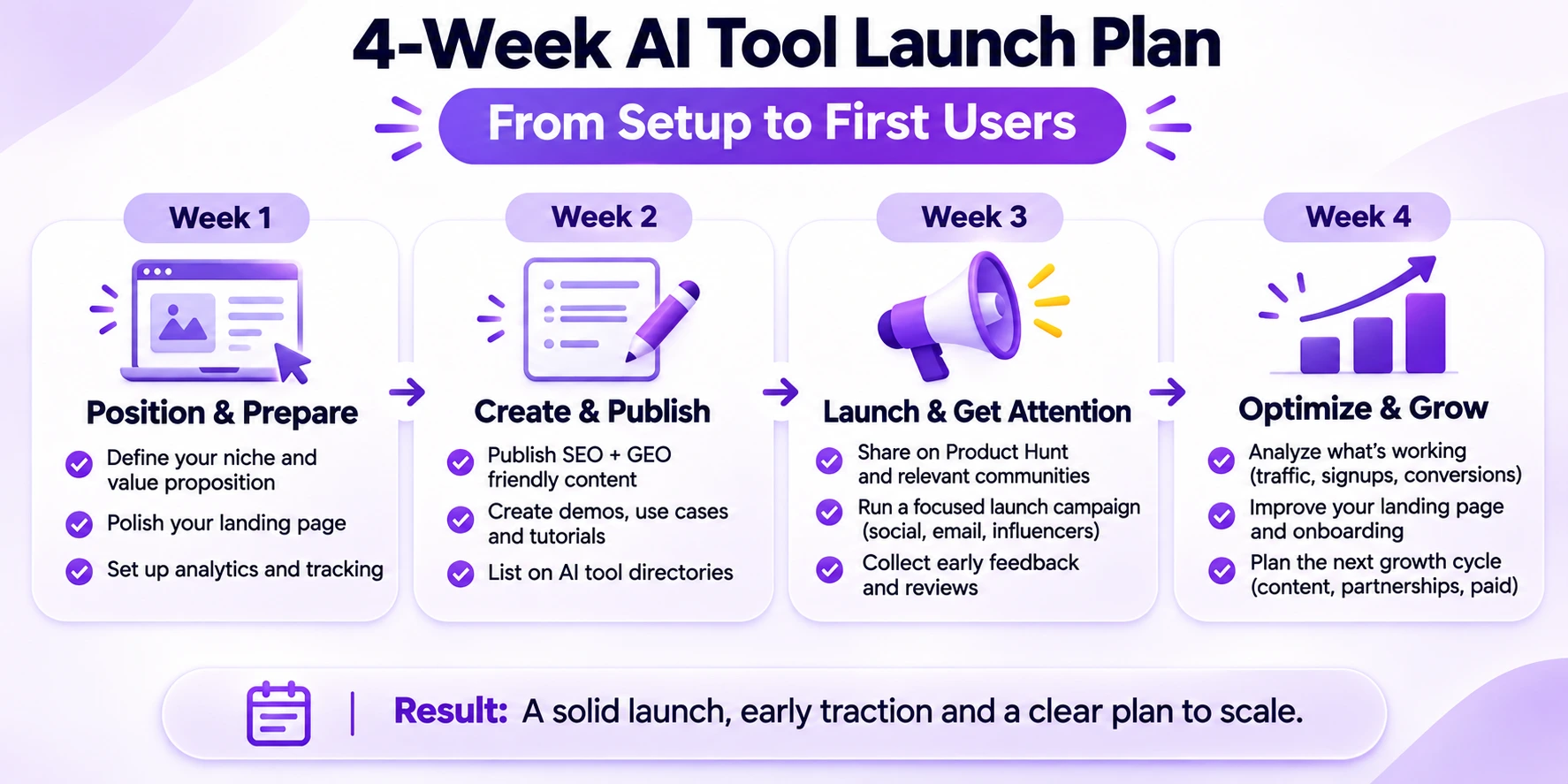
Week 1: Pre-launch foundation
- Build a waitlist with a clear promise, not just "coming soon."
- Recruit 10 to 30 beta users and get named testimonials and short case studies.
- Submit to AI directories now, including Credible AI Tools. Review queues are slow, so do it two to three weeks before launch day.
Week 2: Assets and warm-up
- Prepare a logo, tagline, demo video, 4 to 6 screenshots, a founder story and an email sequence.
- Contribute in the subreddits, Slack groups and forums where your buyers are before you post about your tool.
- Line up 5 to 10 friendly users to try the product on launch day and give honest feedback.
Week 3: Launch
- Choose one lead channel and support it with the rest (see the table below).
- Be present all day. Reply to every comment, fix bugs fast and share updates.
Week 4: Follow-up
- Email every sign-up within 24 hours with one clear next step. Email marketing tools can automate this.
- Turn launch comments into FAQ entries and roadmap items.
- Publish a "what we learned launching" post. It is useful and link-worthy.
- Ask happy early users for G2 and Capterra reviews while the experience is fresh.
| Channel | Best for | What to expect |
|---|---|---|
| Product Hunt | General and consumer AI tools | A launch-day spike, a badge and some press attention. Launches outside the top ranks see far less, so build an audience first. |
| Hacker News (Show HN) | Developer tools and APIs | A skeptical technical crowd. Honest posts with something to try do best. |
| Reddit and niche communities | Specific, narrow tools | Works if you add value first. Disclose that you are the founder. |
| Founder posts on X, LinkedIn, TikTok | Visual, demo-friendly tools | Chatbase and Lovable both grew on public posts and demos. |
| Indie Hackers, Peerlist | Bootstrapped tools | Engaged builders and useful feedback. |
| AI directories | Discovery and some citations | Generic ones send little qualified traffic. Spend minutes, not weeks. |
| G2, Capterra, GetApp | Tools that teams buy | Essential for procurement-led buying. |
Step 5: Let the product do the marketing
AI tools are unusually well suited to product-led growth because the product can show its value in seconds.
- A useful free tier or trial, with clear limits. Budget the free usage as marketing cost, as Lovable reportedly does.
- Fast time-to-value. Aim for a first result inside 2 to 5 minutes. Pre-load examples and templates so nobody stares at a blank prompt.
- Shareable outputs. Reports, images, summaries or apps with a subtle "made with [Tool]" link create organic loops.
- Free tools and templates that target high-volume searches and earn links.
- Integrations. Slack, Google Workspace, Notion, HubSpot, Shopify, browser extensions and AI-platform app directories. Each integration page is also an SEO and GEO asset. If your tool can plug into AI assistants, read our guide to MCP (Model Context Protocol).
- Affiliate and creator programs. Give niche reviewers free access and a tracked link. Pay recurring commissions if your economics allow.
How to promote your AI tool on a small budget
You do not need ad money to start. Put your effort into one narrow use case, public demos, a handful of communities and pages that answer specific buyer questions. Add paid channels only after those convert.
Onboarding and retention are marketing too
Promotion that brings people into a confusing product only wastes money. Fix these early:
- Define your "aha moment," the one action that predicts a user will stay, and guide every new user to it.
- Send a short welcome sequence: day 0 (first result), day 2 (a second use case), day 7 (a team or sharing prompt).
- Ask for feedback inside the product and reply personally in the first months.
- Watch week 1 and week 4 retention. If people leave, more traffic will not help.
Step 6: Community, founder content and video
People trust people more than brands, and trust is the main barrier for AI products.
Where to show up
- Reddit: join the subreddits where your buyers discuss their problems, not only AI subreddits. Answer questions helpfully, disclose your affiliation and mention your tool only where it truly fits.
- LinkedIn and X: share demos, lessons and honest numbers. Show before and after results. Social media management tools help you plan and schedule posts.
- Slack, Discord and Telegram groups in your vertical.
- GitHub (for developer tools): a clear README, examples and active issues build credibility.
- Quora and niche forums: long-lived answers that both search engines and AI systems read.
Content formats that work for AI tools
- Live demos and screen recordings of real tasks.
- Teardowns and comparisons, such as "We tested 7 AI [category] tools on the same task."
- Original benchmarks and data studies.
- Workflow guides, such as "How to [job] with AI in 15 minutes."
- Customer stories with names and numbers.
AI writing assistants can speed up drafting and editing, but add your own data, product experience and point of view so your content stands out.
YouTube and short video
Seeing it work is the sale. Tutorials rank in Google and are read by AI systems through transcripts. Use clear titles, chapters and a script that names your category and use case. Send the tool to niche reviewers with an affiliate link, and cut short clips for Reels, Shorts, TikTok and LinkedIn. An AI video editor makes the cutting faster, and text-to-video generators can help with explainers and b-roll.
Never fake reviews or run sockpuppet accounts. Platforms ban them, and buyers and AI engines notice.
Step 7: Reviews, PR and earned media
Because AI engines and buyers lean on third-party validation, this step often separates tools that get recommended from tools that do not.
- Review platforms: build profiles on G2, Capterra, GetApp and Product Hunt. Ask for reviews systematically, and reply to each one.
- "Best of" lists: pitch the writers behind "best AI [category] tools" articles with free access, a clear fact sheet and honest differentiation. AI engines often use these as sources.
- Digital PR: pitch original data to journalists and industry newsletters. A study with a quotable number earns links and mentions.
- Expert commentary: put the founder forward for podcasts, guest posts and quotes in your niche.
- Newsletters: try AI and industry newsletters with a small test before committing a larger budget.
- Entity profiles: keep LinkedIn, Crunchbase and similar profiles accurate and consistent.
Step 8: Paid acquisition and partnerships
Paid works best after you have found positioning and a conversion path that work organically. Tools for writing and testing ads are listed in our Ad Campaign Tools category.
- Google Search ads on high-intent terms, competitor alternatives and use-case queries.
- LinkedIn ads for B2B tools with a defined job title and company size.
- Meta and YouTube ads for consumer and SMB tools with strong visual demos.
- Retargeting visitors and trial users who did not convert.
- Newsletter, podcast and creator sponsorships in your niche.
Set a target customer acquisition cost against lifetime value before you scale, test message and creative cheaply first, and send ad traffic to focused landing pages instead of your homepage.
Partnerships
- Agencies and consultants who can implement or resell your tool.
- Complementary software with integration listings and co-marketing.
- Course creators, communities and associations in your niche.
How to promote your AI tool in India
With about 100 million weekly ChatGPT users (as OpenAI's CEO said in February 2026) and the largest student base worldwide, India is a major audience for AI tools, whether you sell here or want Indian buyers to find a global product. These are practical suggestions:
- Show INR pricing and support UPI or local cards, with GST invoices for businesses.
- Offer student and startup plans. Students are the largest group, and they carry tool habits into their workplaces.
- Add Hindi and regional-language pages and demos where your product supports them.
- Address data questions plainly, including where data is stored and how you handle India's data protection rules.
- Use local proof: Indian customer stories, local communities and Indian startup and SaaS directories.
- Be present on LinkedIn, X, YouTube and WhatsApp communities, where Indian founders and buyers share tool recommendations.
Step 9: Measure what matters
Any plan for how to promote your AI tool needs numbers behind it, so track these stages.
| Stage | Track |
|---|---|
| Awareness | Branded search, direct traffic, social mentions, share of voice |
| AI visibility | Mentions and citations across AI engines for your test prompts; AI-referred sessions |
| Acquisition | Sign-ups by channel, cost per sign-up, landing page conversion |
| Activation | Share of new users reaching the key action in their first session |
| Retention | Week 1, week 4 and month 3 retention, churn |
| Revenue | Trial-to-paid, MRR, CAC, LTV, payback period |
| Advocacy | Reviews, referrals, NPS |
To turn these numbers into dashboards, see our Business Intelligence and Data Analytics categories.
How to track AI traffic
- Segment AI referrals in GA4 by source:
chatgpt.com,perplexity.ai,gemini.google.com,copilot.microsoft.com,claude.ai. - Ask at sign-up: "How did you hear about us?" with an "AI assistant" option and a free-text box. Keep a log of exact quotes.
- Expect undercounting. Many AI-influenced visitors arrive through Google or a typed URL, as the Gumlet example shows.
- Track branded search growth. A rising brand-name search trend with no clear cause is often AI at work.
Your 90-day promotion plan
Here is how to promote your AI tool in 90 days, with each phase building on the last.
| Days | Focus | Key actions |
|---|---|---|
| 1 to 14 | Foundation | Positioning statement; homepage, pricing and use-case pages; demo video; analytics and AI-referral tracking; entity profiles |
| 15 to 30 | Pre-launch | Beta users and testimonials; directory submissions; community warm-up; two comparison pages; list your 25 test prompts |
| 31 to 45 | Launch | Launch on your lead channel; founder posts; email waitlist; reply to every comment; first reviews |
| 46 to 60 | Convert | Fix onboarding and activation; learnings post; 3 to 5 use-case pages; demo videos |
| 61 to 75 | Compound | Original data study; pitch list authors and newsletters; free tool; first AI-visibility audit |
| 76 to 90 | Scale | Double down on the top two channels; small paid tests; affiliate program; refresh top pages; set 6-month goals |
Launch-ready checklist
- One-sentence positioning statement written and tested on five buyers.
- Homepage, pricing, use-case and comparison pages live.
- Demo video under 60 seconds.
- Security and data page published.
- Three named testimonials or case studies.
- Profiles created on G2, Capterra, LinkedIn, Crunchbase and relevant directories.
- GA4 AI-referral segment and a "how did you hear about us?" field added.
- 25 buyer prompts saved for monthly AI-visibility tests.
Common mistakes to avoid
Knowing how to promote your AI tool also means knowing what wastes time. Avoid these:
- Launching once and disappearing. The spike fades within days. The compounding channels last.
- Targeting everyone. Broad positioning kills conversion and makes you invisible in AI recommendations.
- Hiding pricing and limits. It reduces trust and removes quotable facts for AI engines.
- Writing broad pages instead of pages for specific buyer questions.
- Relying on generic directories. Some traffic, little of it qualified.
- Faking social proof. It damages your reputation and can get you banned.
- Ignoring data and security questions. Buyers want to know where their data goes.
- Overpromising what the AI can do. Show honest limits. Accuracy is your reputation.
- Trusting referral reports alone and missing AI-influenced sign-ups.
- Measuring vanity metrics. Upvotes and page views do not pay salaries. Activation and retention do.
- Publishing thin AI-written content at scale. If your blog reads like everyone else's, neither Google nor AI engines have a reason to cite you.
Sources
Checked on 15 November 2026. Growth figures are reported by the companies, founders or agencies involved. Third-party sources are marked.
- Stripe: Chatbase customer story (first customer, $10M ARR in March 2026), with the founder's account in Starter Story and a profile at Yespress (third party)
- Lovable: Zero to $10M ARR in 2 months (company), with Growth Unhinged (third party)
- DerivateX: Gumlet case study and its follow-up on Gumlet's sign-ups (agency-reported)
- SE Ranking: AI traffic study; Conductor and Digital Bloom figures via DEV Community (third party); BrightEdge figure via Mezha (third party)
- Ahrefs: Why ChatGPT cites one page over another, summarised by Search Engine Journal
- GEO: Generative Engine Optimization (research paper), with Search Engine Land's coverage
- Search Engine Land: SparkToro zero-click study
- TechCrunch: India has 100M weekly ChatGPT users
Frequently asked questions
How do I promote an AI tool with no budget?
Start with sharp positioning, a clear site and a short demo. Then build in public on X, LinkedIn or TikTok, join niche communities, launch on one lead channel, list on review sites and write pages for specific buyer questions. Chatbase's founder reports reaching $1M ARR in 117 days, mostly through organic channels such as a launch tweet, public building and free chatbots.
Is Product Hunt still worth it for AI tools?
Yes, with realistic expectations. It gives a visibility spike and social proof, but it works best after you have built an audience, as Lovable did, and as one part of a multi-week launch. It matters less for tools sold through procurement.
How do I get my AI tool recommended by ChatGPT or Perplexity?
Rank in normal search first, because most ChatGPT citations come from search results. Then write pages whose titles and URLs match the specific questions buyers ask, keep facts current, and earn mentions on review sites, lists and news. There is no guaranteed trick, but these inputs consistently help.
What is the difference between SEO, GEO and AEO?
SEO aims to rank pages in search results. GEO (generative engine optimization) and AEO (answer engine optimization) aim to get your brand cited inside AI answers. They overlap heavily, and strong SEO is the foundation for both.
How much traffic will AI search send me?
Less than most headlines suggest. Studies range from about 0.3% to 1.1% of traffic on average. The influence is larger than the click count, because buyers often search your brand name afterwards.
How long does it take to see results?
Launch channels can bring first users within days. SEO, GEO, reviews and community reputation usually take three to six months to compound. Plan a 90-day sprint, then keep improving.
Which channel is best for a B2B AI tool?
Usually a mix: search for high-intent queries, G2 and Capterra for validation, LinkedIn founder content, a few well-chosen communities and partnerships. Product Hunt can help, but rarely drives tools that teams buy.
Do I need a blog?
Yes, but not a generic one. Publish only where you can add original data, product experience or a clear point of view: comparisons, use-case guides, benchmarks and workflow tutorials.
Should I build a free tool?
If you can make a single-purpose tool that solves a real, searched-for problem and leads naturally to your product, yes. It can attract search traffic and links. It still needs distribution beyond one page.
How do I promote an AI tool in India?
Use INR pricing and local payment options, offer student and startup plans, add regional-language content where relevant, explain data handling clearly, and show Indian customer proof on LinkedIn, X and YouTube.
Conclusion
How to promote your AI tool in 2026 comes down to four things: a sharp position in a market people already search for, a website and product that convert curiosity quickly, a launch that is a sequence rather than a single day, and a reputation across the web strong enough that both people and AI engines feel safe recommending you.
Start with positioning, build the foundation, launch in a focused way, then invest steadily in the compounding channels: SEO, GEO, reviews, community and original content. Measure activation and AI visibility, not just clicks. The AI tools that win will not necessarily be the most impressive. They will be the easiest to find, understand and trust. For tools that can help along the way, browse our Marketing & Sales category.
Get your AI tool discovered
List your tool in our directory and reach people already searching for AI tools.
Submit your AI tool Browse categories