AI & ML Terms Explained: The Top 20 You Should Know
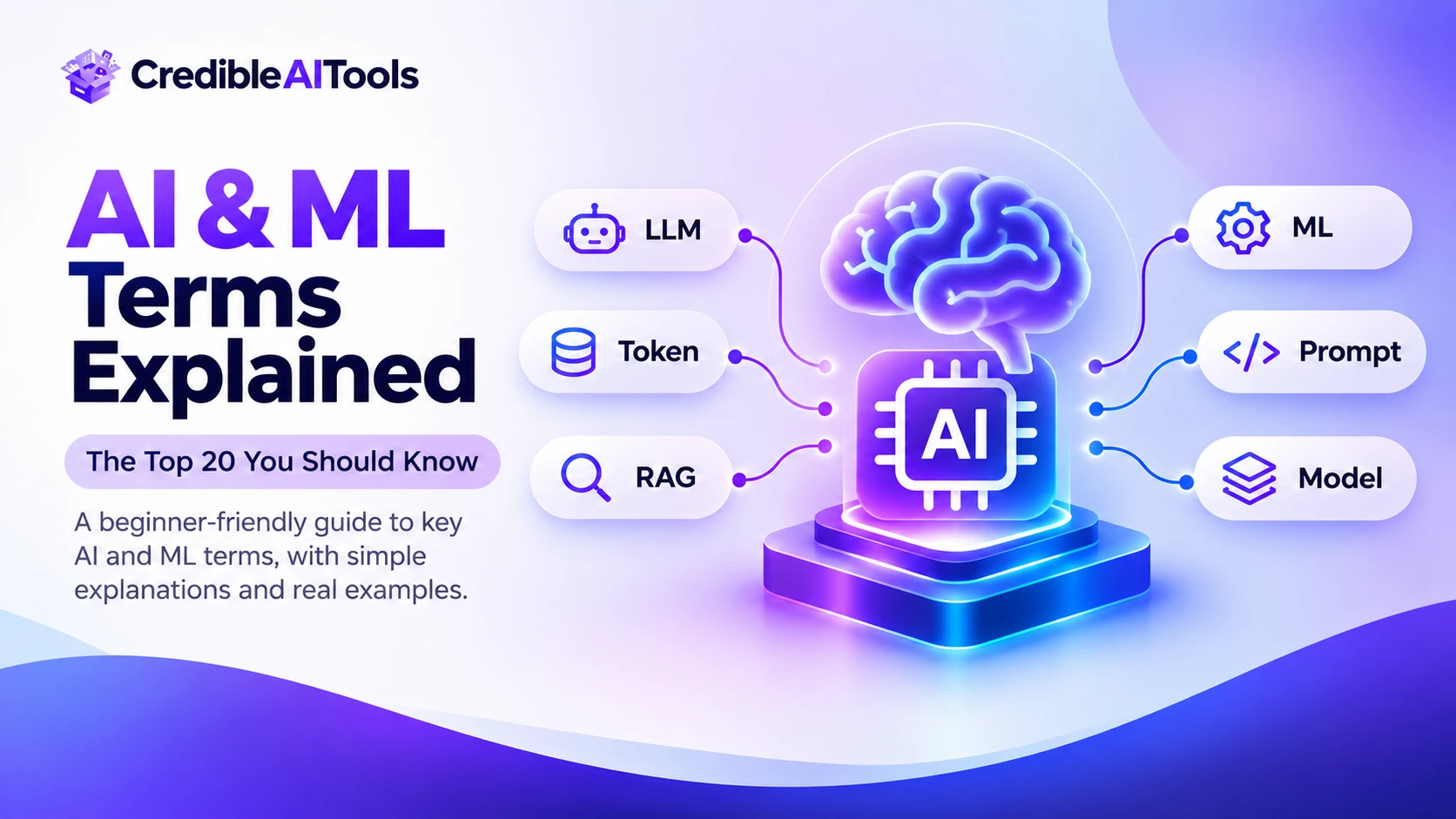
You open a news article, a job post, or a product page, and the jargon hits you. Tokens, models, inference, RAG. It feels like everyone else got a dictionary you missed.
Here is the good news. AI and ML terms are the shared vocabulary people use to describe how machines learn from data and produce useful output. You don't need a degree to learn them. This guide explains 20 of them in plain English, with examples, limits and risks. By the end, you should be able to follow most AI conversations and ask better questions.
Heads up: AI language changes fast, and new terms appear every year. For deeper or more technical definitions, check the Google Machine Learning Glossary.
What are AI and ML terms? (Quick answer)
AI and ML terms are the core words that describe how artificial intelligence and machine learning systems are built, trained and used. Think of them as a travel phrasebook. You don't need to be fluent to travel. You just need enough words to order food, ask directions and spot when something sounds wrong. These 20 terms do the same job for AI.
They are part of our AI concepts library, where we explain the ideas behind the tools in plain language.

The problem it solves
AI talk is full of words that sound alike or mean different things in different places. That makes it easy to feel lost, or to be misled by marketing.
| Without the vocabulary | With the vocabulary |
|---|---|
| Every AI headline sounds the same | You can tell what is actually new |
| Marketing claims are hard to judge | You can ask pointed questions |
| Tool pages feel like a foreign language | You can compare tools with confidence |
| You can't spot an AI mistake | You know what hallucination looks like |
| Team meetings feel intimidating | You can join the conversation |
Vocabulary is not expertise. But it is the first step toward using AI tools safely and well.
How the terms fit together
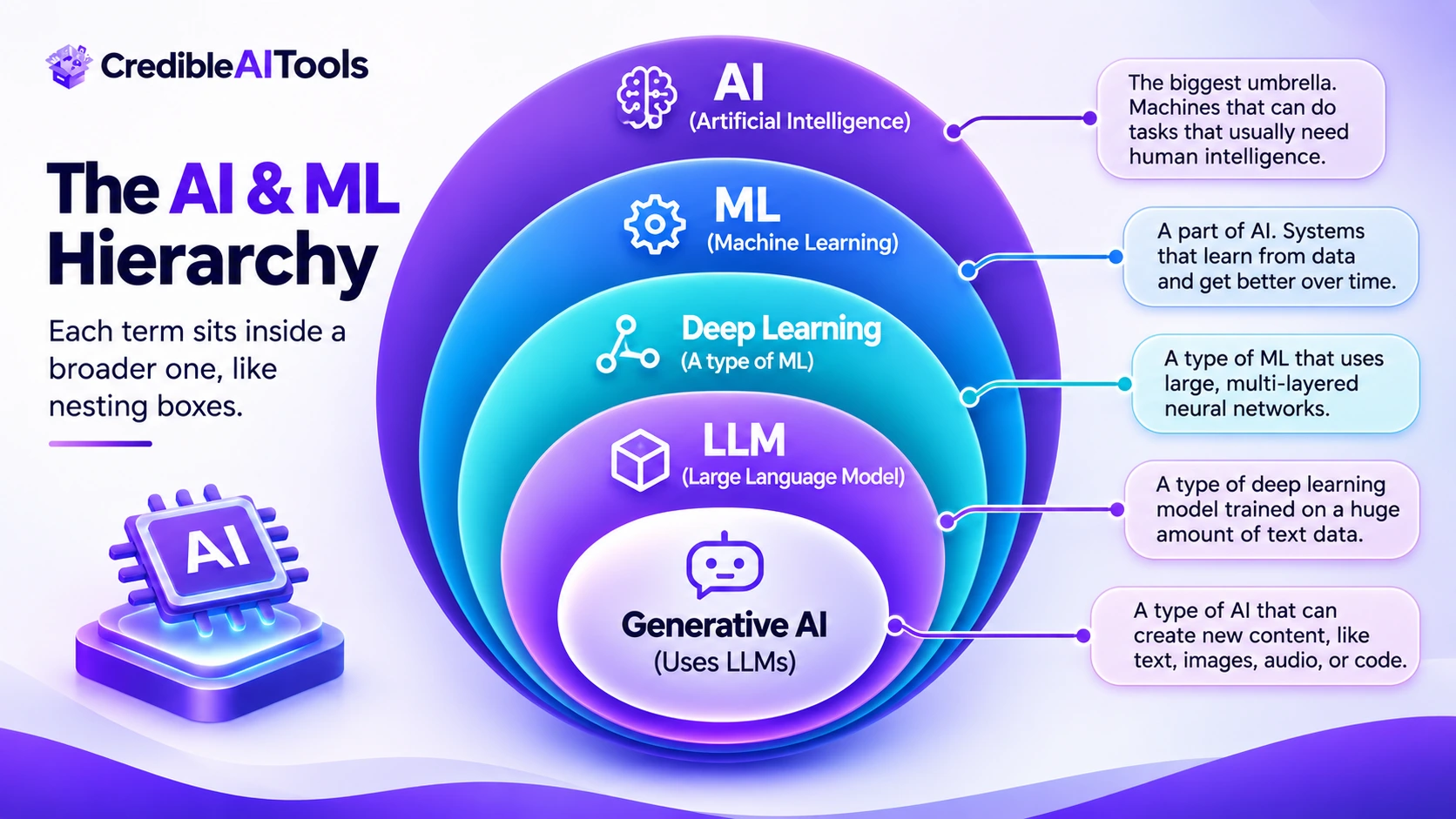
Many of these terms are nested, like boxes inside boxes. AI is the biggest box. The others sit inside it.
| Layer | What it is | Example |
|---|---|---|
| Artificial intelligence | Machines doing tasks that seem intelligent | A spam filter |
| Machine learning | AI that learns patterns from data | Movie recommendations |
| Deep learning | ML using many-layered neural networks | Voice recognition |
| Generative AI | AI that creates new content | Writing or image tools |
| Large language model | Generative AI focused on text | A chatbot |
Each layer is a subset of the one above it. Every LLM is generative AI, and every generative AI system uses deep learning. But not all AI is generative.
The top 20 AI and ML terms
We've grouped these into three sets so they build on each other.
Group 1: Foundations
| # | Term | Plain-English meaning | Everyday example |
|---|---|---|---|
| 1 | Artificial intelligence (AI) | Software that performs tasks needing human-like judgment | Route suggestions in a maps app |
| 2 | Machine learning (ML) | Software that learns patterns from examples instead of fixed rules | Email spam detection |
| 3 | Deep learning | ML that uses large, layered neural networks | Photo tagging |
| 4 | Neural network | A system of connected math units loosely inspired by the brain | Handwriting recognition |
- AI is a broad label, not one technology. Some "AI" is simple rule-based software. Ask what is actually under the hood.
- ML flips traditional programming. Instead of writing rules, you show the computer many examples and let it find the rules.
- Neural networks are math, not brains. The brain comparison is only a loose inspiration.
Group 2: How models learn
| # | Term | Plain-English meaning | Everyday example |
|---|---|---|---|
| 5 | Model | The trained "result" of ML: a file that makes predictions | A translation engine |
| 6 | Training data | The examples a model learns from | Thousands of labeled photos |
| 7 | Training | The process of adjusting a model using that data | Teaching a model to spot cats |
| 8 | Inference | Using a trained model to produce an answer | Asking a chatbot a question |
| 9 | Supervised learning | Learning from examples that come with correct answers | Photos labeled "cat" or "dog" |
| 10 | Overfitting | A model memorizes its training data and fails on new data | A student who memorized past exam papers |
| 11 | Bias | Systematic unfairness or skew in a model's output | A hiring tool that favors one group |
- Training and inference are different stages. Training is learning. Inference is using what was learned. You only do inference when you chat with an AI tool.
- Supervised learning has a sibling. Unsupervised learning finds patterns in data with no labels, such as grouping customers by behavior.
- Your data quality sets the ceiling. A model trained on poor or narrow data will give poor or narrow results.
- Bias usually comes from the data. If the examples are skewed, the model tends to be skewed too. This is a known issue, and it needs active checking.
Group 3: Language and generative AI
| # | Term | Plain-English meaning | Everyday example |
|---|---|---|---|
| 12 | Large language model (LLM) | A model trained on huge amounts of text to predict and generate language | The engine behind many chatbots |
| 13 | Generative AI | AI that creates new text, images, audio or code | Drafting an email |
| 14 | Token | A small chunk of text a model reads, often a word or part of one | "unhappy" may become "un" + "happy" |
| 15 | Prompt | The instruction you give an AI | "Explain this in simple words" |
| 16 | Context window | How much text a model can consider at once | Your whole conversation so far |
| 17 | Hallucination | A confident answer that is wrong or made up | A citation that doesn't exist |
| 18 | Fine-tuning | Extra training to specialize an existing model | A model tuned for legal wording |
| 19 | RAG (retrieval-augmented generation) | The AI looks up relevant documents before answering | A chatbot reading your help center |
| 20 | AI agent | An AI system that plans and takes actions toward a goal | A tool that books meetings for you |
- LLMs predict text. They generate the most likely next token, over and over. That is powerful, but it is not the same as "knowing" facts. Popular examples include ChatGPT and Claude. You can compare more in our General Chatbots category.
- Tokens affect limits and cost. Many tools measure usage in tokens. Check each product's documentation for how it counts them.
- Context windows are not unlimited. Once a conversation grows too long, older details may be dropped or handled poorly.
- Hallucinations are a design limit, not a rare glitch. Always verify important facts.
- Fine-tuning and RAG solve different problems. Fine-tuning changes how a model behaves. RAG gives it fresh information at answer time.
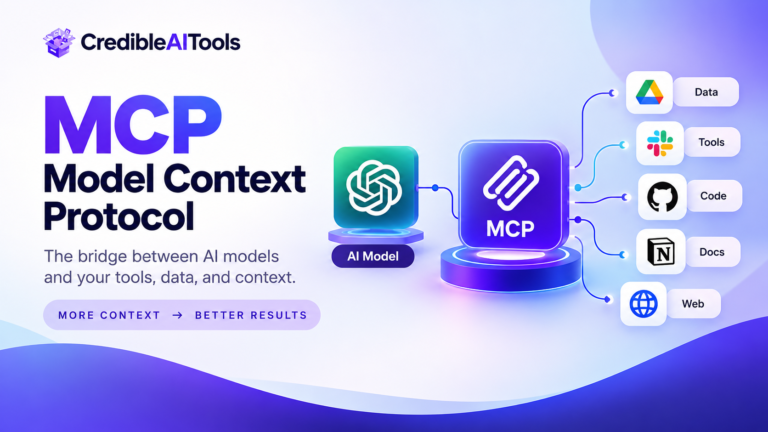
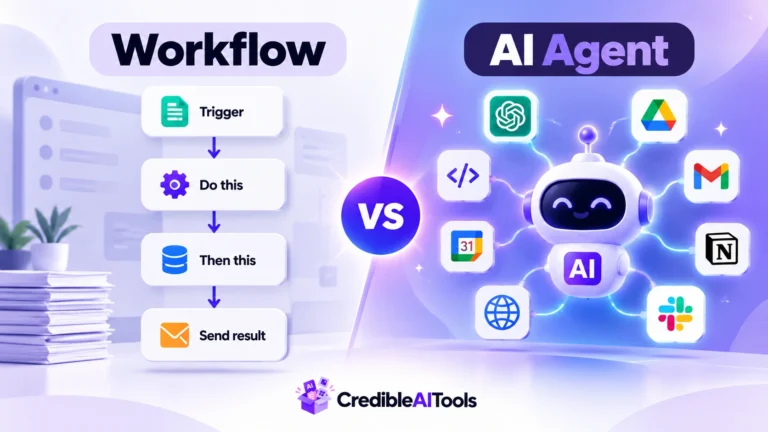
- Agents act, not just answer. That is useful, but it raises the stakes if something goes wrong. We compare them in AI agents vs workflow automation, and you can browse examples in our AI Agents category. To see how agents connect to outside tools, read our guide to MCP (Model Context Protocol).
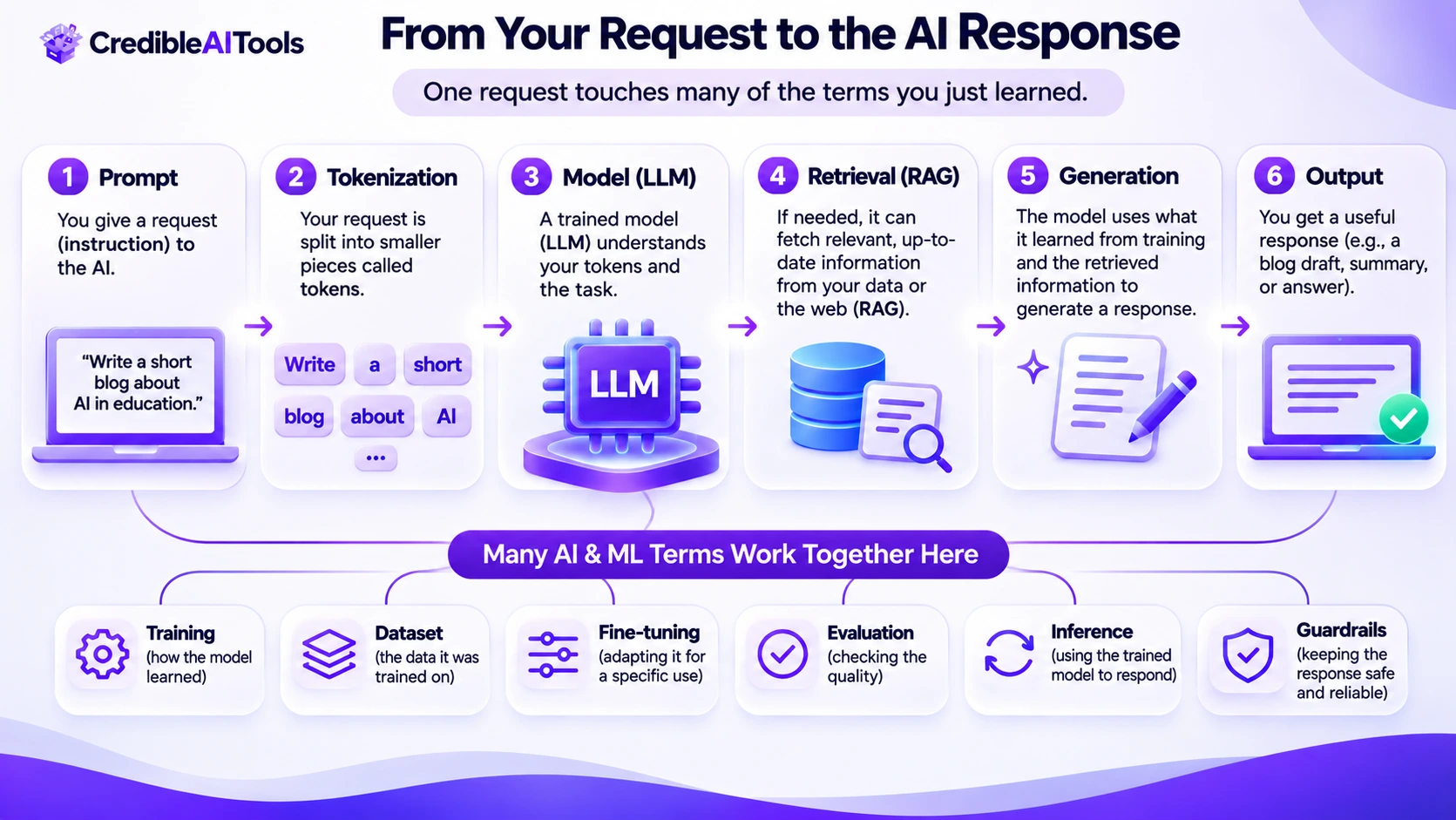
How these terms work together: a real example
Say you tell an AI assistant: "Summarize this 20-page report and list the action items." Here is what happens.
- Your request becomes a prompt. The AI treats your words, and the pasted report, as its instructions.
- The text is split into tokens. The model reads small chunks, not whole sentences.
- The context window is checked. If the report is too long for the window, the tool may cut it or ask you to shorten it.
- Optional lookup (RAG). If the tool is connected to your documents, it may pull relevant passages first.
- The LLM runs inference. The already-trained model predicts the summary one token at a time.
- You get the output, and you review it. The summary might miss a point or invent a detail. That is a hallucination, so check it against the source.
Six steps, and nearly every term shows up. That's why learning them pays off quickly.
Key benefits of knowing these terms
- Clearer thinking. You can describe what you want from an AI tool in precise words.
- Better tool choices. Terms like context window and fine-tuning help you compare products on facts, not slogans.
- Smarter skepticism. You can spot vague claims such as "AI-powered" with no details.
- Safer use. Knowing about hallucination and bias makes you check output before trusting it.
- Easier learning. Every future AI topic builds on this base.
What this vocabulary does not do: it won't make you an engineer, and it won't tell you which tool is best for your task. It's a starting point.
Risks and safety checklist
Understanding the terms also means understanding where things go wrong. For a more formal framework, see the NIST AI Risk Management Framework.
| Risk | What can happen | What to do |
|---|---|---|
| Hallucination | A wrong answer sounds confident | Verify facts, names and numbers |
| Bias | Output unfairly favors or excludes groups | Review results, especially for people-related decisions |
| Privacy leaks | Sensitive data pasted into a tool may be stored or used | Read the privacy policy; avoid private data |
| Overreliance | You stop checking the work | Keep a human in the loop |
| Outdated knowledge | The model misses recent events | Use tools with search or RAG, and check dates |
| Agent mistakes | An agent takes a wrong action | Limit permissions; require approval for key steps |
| Overfitting | A model works in tests but fails in real use | Ask how it was tested on new data |
AI and ML terms vs. using AI tools
Knowing the words and using the tools are different skills. You need both.
| Knowing the terms | Using AI tools | |
|---|---|---|
| Goal | Understand what is happening | Get a task done |
| Skill type | Concepts and vocabulary | Hands-on practice |
| Time to learn | A few hours | Days to weeks, and ongoing |
| Main benefit | Better judgment | Better output |
| Main limit | No practical results alone | Easy to trust results blindly |
How they work together: the terms help you judge what a tool is doing, and practice shows you how it behaves.
Are these terms right for you?
| Use this guide if you... | Skip it if you... |
|---|---|
| Are new to AI and feel lost in the jargon | Already build or train models and want technical papers |
| Work with AI tools but want to understand them better | Only need quick tool recommendations right now |
| Need to evaluate AI products for your team or business | Want legal or compliance advice, which needs a qualified professional |
| Want a base before learning deeper topics like agents or RAG | Are looking for a deep technical course |
How to get started in 5 steps
- Pick five terms. Start with AI, ML, LLM, prompt and hallucination.
- Try them in a real tool. Ask a chatbot a question and watch for the terms in action.
- Test its limits. Ask something obscure and check the answer. You'll see hallucination firsthand.
- Explore and compare tools. Browse the CredibleAI Tools directory and notice how listings describe features like context window or fine-tuning.
- Add terms as you go. Learn RAG and agents once the basics feel natural.
Frequently asked questions
What is the difference between AI and machine learning?
AI is the broad goal of machines doing smart tasks. ML is one way to get there, by learning from data.
Is ChatGPT a model or a product?
It is a product built on top of language models. The model is the engine, and the product is the whole vehicle.
What is a token, and why does it matter?
A token is a small piece of text a model reads. It matters because limits and costs are often counted in tokens.
Can AI hallucinations be fully fixed?
Not today. Methods like RAG and better training reduce them, but you should still verify important answers.
What is the difference between training and inference?
Training teaches the model. Inference is when the finished model answers your question.
Do I need to know math to understand these terms?
No. The concepts here are explainable without math, though building models does require it.
Explore more AI tools
Ready to see these terms in real products? Browse the full directory by category, or submit your own tool for manual review.
Browse by category Submit your AI tool